Randomized controlled trials, an especially difficult achievement in a field like this, would be the only way to make it possible to recommend a specific therapy. There is no evidence on plasmapheresis for treatment of monoclonal gammopathy in this setting. A few cases of TMA related with lymphoma and myeloma had detectable antibodies against ADAMTS13, which disappeared once achieving malignancy remission 127,141. In a recent case series, the prevalence of monoclonal gammopathy in a TMA population was five-folder higher than expected (21% versus 4,2%, in patients 50 and older), which may indicate an association between those entities 147. Notwithstanding, recent studies have reported more promising survival rates 8,129.
Mitomycin and gemcitabine have numerous reports of dose-related DITMA, while one report describes an immune-DITMA as a result of gemcitabine administration (19–26). Despite their use as a combination with other drugs, which makes the direct causal relationship difficult in some cases, many well-described cases support a clear-cut association (21, 27, 28). This involves the removal of plasma — water, salts, and enzymes — from the blood. Cancer-related TMA may develop from a cancer itself or from treatment — particularly chemotherapy drugs, such as mitomycin C. Here, we report on two patients with chemotherapy-induced TMA, who were successfully managed with temporary eculizumab therapy and remained relapse free for a follow-up of 47 and 15 months, respectively.
Chemotherapy-Associated Thrombotic Microangiopathy
Another report, identified a highly effective and frequently prescribed fluoroquinolone, levofloxacin as a new potential suspect for DITMA (13). This case report described two patients who developed microangiopathic hemolysis and thrombocytopenia following levofloxacin treatment of respiratory tract infections. Both cases resolved after drug cessation; the first patient received also therapeutic plasma exchange. Moreover, according to consensus opinion (Palma et al., 2021), regardless of whether a toxic or immune-mediated form, a trial of TPE is recommended in all patients with a suspected diagnosis of severe DITMA, in addition to suspected-causative drug suspension.

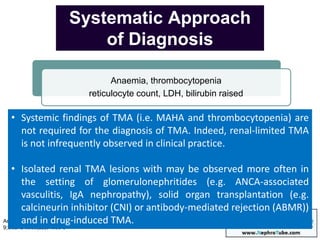
Renal-limited DITMA might be underdiagnosed due to clinical findings limited to the kidney and physicians’ frequent reluctance to perform renal biopsy. This issue becomes even more important in DITMA, considering that TMA renal-limited forms are mainly caused by drugs (28.5%) (Saba et al., 2018). Moreover, if recognized, these forms showed to benefit more from the withdrawal of the causative drug, with a lower relapse risk and better survival rates than the systemic DITMA (Izzedine and Perazella, 2015).
- When secondary TMA is suspected, the following tests will help with the differential diagnosis.
- In the end, parts of your kidney can die from lack of blood flow, and your body can run low on red blood cells and platelets.
- In a fascinating move, Shiga toxin can also bind to Factor H on endothelial surfaces, thus bringing complement into the game.
- In children, TTP is rare, and PE has a more side effects, therefore, complement inhibitors are first line.47 PE remains the only treatment in countries where access to complement inhibitors is restricted due to cost.
- Mechanisms that lead to complement activation or ADAMTS13 deficiency have also been suggested 6,14,15.
List Of TMAs
Three reports have described DITMA caused by pentostatin, a purine analog used in lymphoproliferative diseases (29). Docetaxel and vincristine have also been reported to induce TMA (30, 31). Oxaliplatin has been implicated as a cause of DITMA in a review by Al-Nouri et al. (2), although the authors of the original report described gemcitabine as the causative factor (32). Renal-limited TMA has been reported in three patients treated with pegylated liposomal doxorubicin (33) and in one patient receiving treatment with a short interfering RNA targeted against Myc (DCR-MYC) (5).
2 Cobalamin C AHUS
A 2016 review of research suggests that TMA originating from cancer treatment drugs may be more serious and that the prognosis is more encouraging when TMA develops as a result of the underlying cancer. In most patients with TMA, a complement-activating trigger can be identified, and in 28% of patients with an activating trigger, a genetic risk mutation can be found 3. In agreement with others we found that TPE/plasma infusion was not effective in patients with chemotherapy-induced TMA 12, 13, 14, 15, 16, 17, 18. Thrombotic microangiopathy (TMA) encompasses a group of disorders presenting with microangiopathic hemolytic anemia (MAHA), thrombocytopenia, and ischemic organ damage, most frequently of the kidneys and the central nervous system 1, 2. In many of the more atypical TTP/HUS disease patterns the optimal treatment has not yet been standardized. These are often treated (like TTP) with plasma exchange, but there is currently some debate about this.
Tyrosine Kinase Inhibitors
Primary TMAs mainly include hereditary or acquired forms of TTP and primary atypical hemolytic uremic syndrome (aHUS). Their pathogeneses are well-understood, and their respective diagnosis and treatment are well-developed. Drugs (including chemotherapy), pregnancy, malignant hypertension, autoimmune rheumatic diseases, infection, transplant, and malignancy constitute the secondary TMAs (Figure 1). Example published cases of type I (chemotherapy) and type II (targeted therapy) antineoplastics are presented along with therapeutics explored and outcomes where available. The overactivation or deregulation of complement system is not proven in DITMA patients and, consequently, indications for eculizumab treatment are limited. Some Authors (Cavero et al., 2017; Caravaca-Fontan and Praga, 2019) suggest to use the anti-complement therapy only in case of lack of improvement of hematological parameters and/or renal function recovery after causative drug discontinuation.
5 Genetic Complement‐mediated AHUS
The ultimate outcome of all thrombotic microangiopathies is ischemia in the terminal vascular bed of organs. In 1926, Elias Moschkowitz first reported a fatal thrombotic microangiopathy in a 16-year-old female patient who presented with anemia, fever, hemiparesis, and coma (6). Autopsy revealed multiple intravascular thrombi especially in the heart, but also in the kidneys and brain. The latter inhibits the vWF-cleaving protease and leads to uncontrolled thrombosis of small and micro blood vessels in almost all organs. This results in the clinical picture of an immune-mediated, acquired thrombotic thrombocytopenic purpura (aTTP) (figure 2). In contrast, in hemolytic uremic syndrome (HUS), thrombus formation almost always occurs in the kidneys, although it may affect other organs in some patients.
- While immune-mediated damage generally shows acute onset within 2 – 3 weeks of drug exposure, the clinical manifestation of cytotoxic damage is either acute or slowly progressive with cumulative dose-dependent toxicity 5, 8, 9.
- Coagulation screen is normal in TMA in contrast to elevated PT and aPTT and low fibrinogen in disseminated intravascular coagulation.
- Genetic testing is recommended in all patients with recurrent episodes of hypertensive emergency, TMA, and progressive kidney disease.
- PT contributed to histological diagnosis, providing photographs of biopsies, and their description.
- However, conflicting results were reported by previous articles gemcitabine-induced TMA treated with C5-inhibitor (Al Ustwani et al., 2014; Daviet et al., 2019).
7 Acquired Complement‐mediated AHUS

Thrombotic microangiopathy is a syndrome triggered by a wide spectrum of situations, some of which are specific to the Oncology setting. It is characterized by a Coombs-negative microangiopathic haemolytic anemia, thrombocytopenia and organ injury, with characteristic pathological features, resulting from platelet microvascular occlusion. In systemic lupus erythematosus (SLE), scleroderma renal crisis (SRC) or catastrophic antiphospholipid syndrome (CAPS) presentations with TMA are well recognized although the mechanisms are unclear. TMAs related to malignancy can either be a direct consequence of the malignancy or the chemotherapy agents used to treat it and it is generally difficult to differentiate between the two.

Variants in Thrombomodulin (THBD), a transmembrane glycoprotein with anticoagulant properties and a negative regulator of the complement system on vascular endothelial cells, may lead to a TMA. If not identified and treated in a timely manner, prognosis is the worst in patients with Factor H mutations, with 60%-70% reaching kidney failure within a year of disease onset. Patients with CD46 mutations have a better prognosis, with approximately 80% remaining dialysis-independent.
Drug-induced Thrombotic Microangiopathy: A Systematic Review Of Published Reports
These data suggest a variable complement involvement, a likely different susceptibility to anti-complementary drugs and an heterogeneity of the DITMA mechanisms. This will require deeper evaluation of the DITMA pathophysiological mechanism for future reclassifications and drug/disease-based treatment. Nevertheless, several problems still need to be solved to clarify the role of complement in DITMA (as in other secondary TMA forms). Focusing on those patients with decreased serum complement factors, they all had positive IF staining.
The lamina rara interna layer of the glomerular basement membrane (GBM) was expanded. Creatinine later improved (1.4 mg/dl at 2 months and 1.0 mg/dl at 6 months). Several observational studies and case series reported other treatment options, all of which require further study. Defibrotide is a fibrinolytic, anti-thrombotic, anti-inflammatory, and thrombolytic agent, that could protect against endothelial damage by inhibition of TNFα (supported by in vitro studies) 132, 133, 134. This drug protects endothelium from CNI and mTORI actions and has been used to prevent GVHD 134, 135, 136.
While more than 130 adult and pediatric TA-TMA patients have been treated to date under the narsoplimab extended access program (EAP), our study is limited to the 20 EAP patients treated at our institutions. Therefore, it does not enable a comparison with other complement inhibitors (such as eculizumab 30,31,32), occasionally used for TA-TMA treatment. Several case reports describe a fast hematologic response, sometimes achieved after one cycle of chemotherapy. Patients who initiate early chemotherapy have a better prognosis, with a considerably higher survival rate and a good quality of life. Plasmapheresis could be useful if antibody-mediated TMA is suspected 10,142.